The Whole Spiel
by Sarah Leavitt, Director of Curatorial Affairs
October 2, 2026
What do you want to be when you grow up?
Since I was a sophomore in college, I’ve only had one job: Museum. (Like Ken’s “Beach” career from the Barbie movie, but even better). I dabbled in being a camp counselor, and I taught a college class one semester (same skill set) but ultimately, I’ve just been on this one-job trail since I was 19 years old. Which is perhaps why I was so excited this month when our lobby cases at the Lillian and Albert Small Capital Jewish Museum focused in on some Jewish Washingtonians with unusual careers. I don’t have a “wait, that’s a job?” sort of career myself, but at least I get to write about them.
This month’s lobby cases reveal two different kinds of career trajectories: An accordion player enjoys a long career in music; and a government attorney sells hot dogs out of a cart on the weekends. See, kids? Whether you dream of becoming an accordion player, a hot dog vendor, or even a museum curator, make sure your parents take you seriously when you tell them what you want to be when you grow up. Anything is possible!
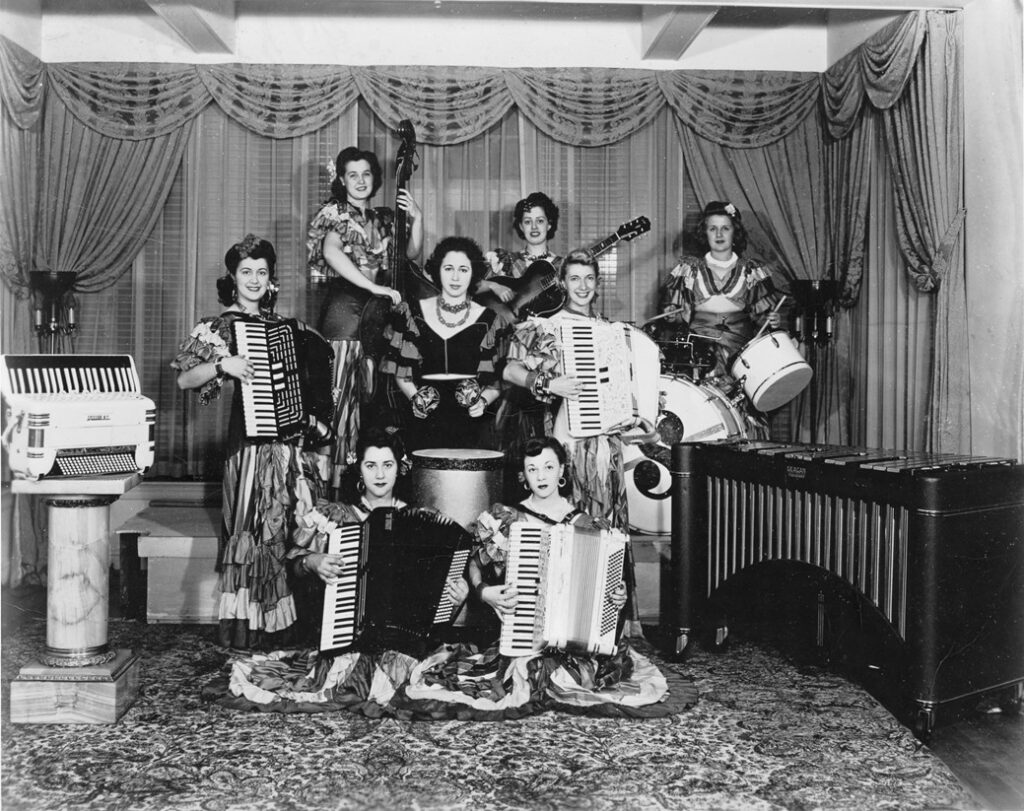
Sylvia Kaplowitz with her band, 1939. Gift of Brett Kaplowitz.
“Who is Sylvia?”
First up, we have our accordion aficionado: Sylvia Klavans Kaplowitz (ca. 1904–1981). Sylvia came of age in an accordion-forward era; in the 1930s, accordions were popular instruments for vaudeville shows, evening soirees, and association luncheons. And she played all of these. Sylvia was a classically trained musician who studied at the Peabody School of Music in Baltimore, where she was from. She didn’t just play the accordion—though newspaper references show that she did play a lot—but was also a radio personality and a long-time local music teacher. She also sometimes entertained audiences on the piano or the organ. But it seems she most often performed on accordion, at least from reading several newspaper accounts such as this one from the Evening Star in August of 1933: “Mrs. Slvia Kaplowitz suddenly appeared out of nowhere, bearing an accordion which she played well. She was vigorously applauded.”
In the 1930s, Kaplowitz hosted her own radio show, “Who is Sylvia,” on WMAL, a relatively new station at the time. Founded in 1925 by a career-switching optician named M.A. Leese, WMAL provided a platform for budding accordionist Sylvia Kaplowitz. I wish I could tell you what her radio show involved, but there are no extant recordings.
During World War II, Kaplowitz formed an all-girl accordion band that traveled across the region, performing at hospitals and USO centers, raising funds for war bonds. And she parlayed that experience into a career as an accordion teacher after the war. Reminiscences online show that many DC-area accordion players got their start in her studio. Sylvia continued to perform at the highest level—she famously played at the White House for four US presidents. And she often provided music for luncheons and other events throughout the city, from the Jewish Community Center to the National Press Club. Meanwhile, her husband Abraham was a co-founder of the Kaplowitz Brothers ladies’ apparel store, which marketed clothing as “Fashions De Luxe.” Perhaps she wore some of his merchandise while performing. Together, Syvia and Abraham were involved with several local Jewish organizations, including B’nai B’rith and Hadassah.
Sylvia is (so far) the only accordion player represented in CJM’s archive. Weirdly, we also only have one hot dog vendor.
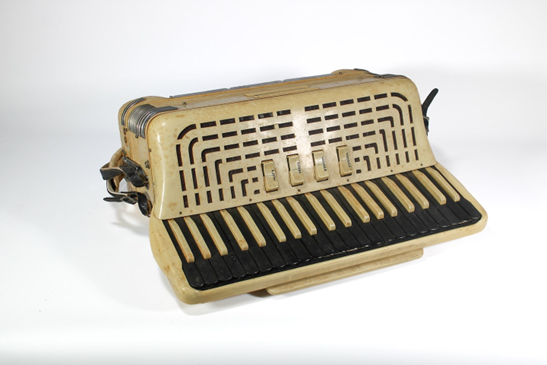
Excelsior Accordion belonging to Sylvia Kaplowitz, Gift of Brett Kaplowitz.
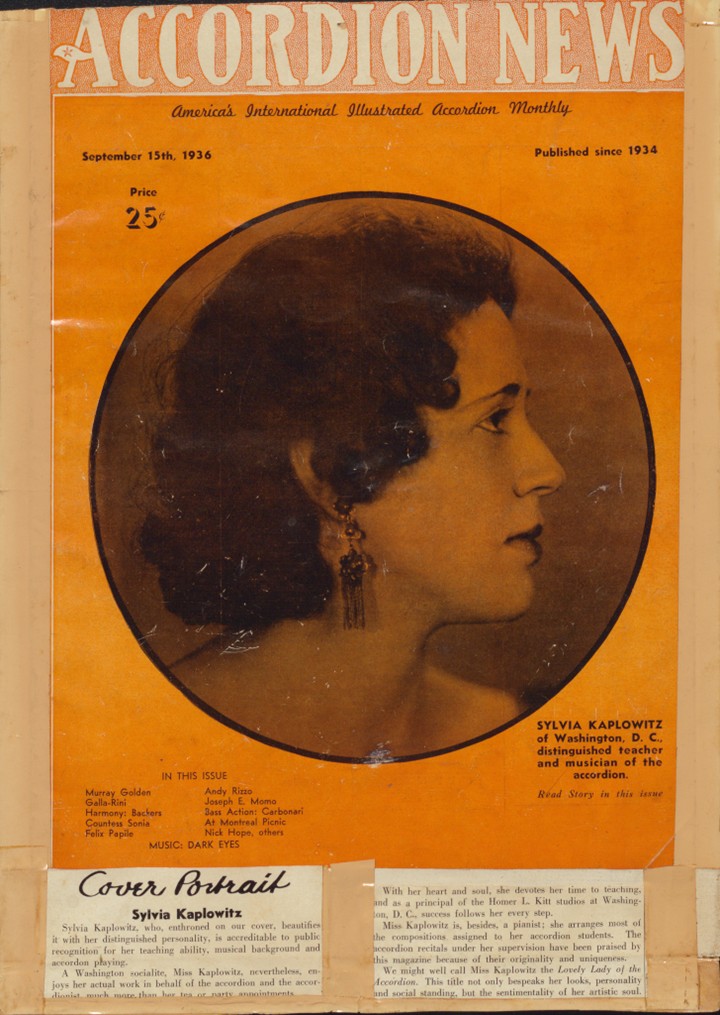
Sylvia Kaplowitz on the cover of Accordion News, September 15, 1936. Gift of Brett Kaplowitz.
Furloughed Government Employee Turned Hot Dog Guy
Isaac Stein actually has two careers, simultaneously. And not two careers you would guess are compatible: a hot dog vendor and a government tax lawyer for the IRS. To hungry Washingtonians at the corner of 1st and M Street NE, Isaac Stein is the viral, suit-and-tie-clad “Hot Dog Guy.” To the federal government, he is the suit-and-tie-clad tax lawyer within the Internal Revenue Service (IRS) Office of Chief Counsel. And here at the Capital Jewish Museum, we are proud to have his collection of hot dog-related ephemera, including the umbrella from his cart.
Stein, who hails from Connecticut, had wanted to own a hot dog stand ever since first working at a concession stand during middle school basketball games. He started selling hot dogs full-time during the federal government shutdown in 2025. As it happens, before the shutdown cleared his schedule, Stein had spent thousands of dollars out of pocket to buy a professional hot dog cart, treating it as an “art project” and fulfilling a childhood dream.
On indefinite furlough from the IRS Chief Counsel’s Office, he seized the moment to launch Shysters Dogs full-time in NoMa. Famously wearing his government-lawyer suit to sell hot dogs, Stein made a sartorial comment with a modern, DC-specific twist on the historic Jewish immigrant merchant tradition. Though his work might echo the early 20th-century Jewish street vendors, these entrepreneurs were pursuing an eventual future in a brick-and-mortar store. For Stein, the corner stand was the actual plan the whole time. He captured the spirit of his DC forefathers as a form of community-building during a tense political shutdown. Though he always intended to go back to the office (and did so, once the shutdown had ended), Stein was able to bring some joy to DC residents who often got a laugh while buying lunch.
An expert on writing complex employee benefit regulations, Stein channeled his bureaucratic expertise into filing paperwork for his weekend passion project. “Getting the permits for a hot dog cart cleared through the DC bureaucracy, in my opinion, was harder than the bar exam,” he told the press in 2025. Shysters Dogs sells hot dogs the “correct” way, with only mustard: Shysters charges extra for ketchup.
Stein shared that his sharp attire was “intended as an artistic comment” on a city obsessed with status. Beyond the performance art aspect, the venture allowed him to spark human connection during a stressful time for his fellow federal workers. As Stein reflected on the crowded, smiling lines gathering daily beneath his yellow umbrella, he noted that “the unifying theme… is just pure, unadulterated happiness and joy.”
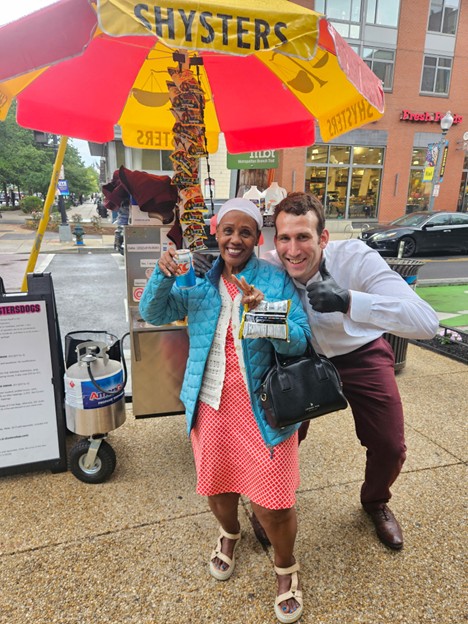
Isaac Stein with "Ziggy," who ran a hot dog cart on the National Mall in the 1980s, in front of Shysters Hot Dogs, 2025. Gift of Isaac Stein.
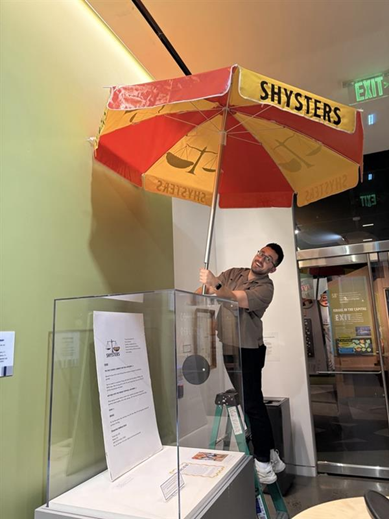
Shyster’s hot dog stand umbrella, museum installation, 2026. Gift of Isaac Stein.
Career Advice from the Capital Jewish Museum
Just kidding, we don’t have any. (Unless you want your career to be Museum: apply for an internship here!). But if your dream takes you to a gig playing the accordion at a fancy luncheon or selling a hot dog for a (less-fancy) streetside meal (and—maybe especially—if you are a federal government tax lawyer), just remember that you are part of a long line of Jewish Washingtonians, and your story, too, can find its place at the Capital Jewish Museum.
***
The IRS Lawyer/Hot Dog Vendor and Accordion Player exhibition cases will be on display in the CJM lobbies on the 1st and 2nd floors for the month of October 2026.
We are always looking for more stories of Jewish federal workers. Is there a box of artifacts (it doesn’t need to be a hot dog-themed umbrella, but we’re open to it) or photographs in your house somewhere that might help us preserve and teach the stories of Jewish federal workers? Do you have a history of working for the government, or do you know somebody who does? Please have them email our curatorial staff at: [email protected]. Thank you!
The Museum’s initiative to collect items telling the stories of local Jewish federal workers is supported by Sue Ducat in memory of Stanley Cohen z”l.