The Whole Spiel
by Kerry Reed, Oral Historian
February 27, 2026
Last year, the Museum launched a new oral history initiative to record, preserve, and share the stories of Jewish Washingtonians, thanks in part to a matching seed grant from The Dr. Cyrus Katzen Foundation and additional generous support from our community. A growing field in historical research, oral history is the practice of recording conversations as primary sources that document recollections of a significant event, societal change, or everyday life. Here, the Museum’s Oral Historian Kerry Reed describes the importance of this research and his approach to recording such personal stories.
********
Conducting oral histories is a bit of an art form. No two oral historians are going to approach an interview the same.
The three main components of an oral history (the pre-interview, the interview, and the post-interview) provide ample room for interpretation, which makes oral history one of the more personal research methods used by historians. Indeed, the fluidity of the approach and the human capacity to misremember events have led some historians to see oral histories as less trustworthy than traditional paper sources. But for me, oral histories have a way of soliciting empathy more easily than archival sources. Maybe it is the narrator’s proximity to us, the tenor in a voice recalling joy or the protracted silence while remembering pain; maybe the false starts, familiar vernacular, and the listener’s knowledge of what it is to share emotion, to share memories, makes an oral history feel more human. Regardless of what may happen to an oral history after the fact, my goal for any oral history is to experience the life story of a narrator with them.
My approach to finding a narrator is simple: who has witnessed, participated in, or remembers historically significant events, processes, or phenomena. This could be somebody who participated in the Million Man March in 1995, saw the plane hit the pentagon on September 11, or served on a synagogue’s board or committee for a long time. Everyone’s history is worth listening to and recording, but time forces me to prioritize, and so I try to find narrators who can speak to an absence in the historical record.
For the pre-interview, I like to spend an hour with a narrator asking them questions about their life. I think this creates a sense of trust between us and makes it more likely that they will share their story during the interview. While I always have a specific topic that I would like to cover during an interview, the rest of the interview is up to the narrator. If a narrator wants to speak about hobbies, family, travel, whatever they would like to share, that’s perfectly fine. I encourage narrators to establish their historical subjecthood for themselves during the pre-interview so they can begin to think about how they would like to respond to the questions I will ask.
After the pre-interview, I’ll draft a couple of pages of questions and send them to the narrator for approval. Once everything is agreed upon, we schedule a time and place for the interview. I will record in any space that is quiet, but I particularly love it when a narrator invites me into their home. Not only is this the most comfortable setting for a narrator, but it also gives me some insight into their lives. Homes are laboratories for identity, and referencing a piece of artwork or a photograph can buoy an interview. Moreover, having cherished objects within reach frequently spurs storytelling. The more engaged a narrator is, the better.
As we move through the pre-approved list of questions, I will often ask follow-up questions. These follow-ups can serve a variety of purposes: clarification, elaboration, or maybe to provide the narrator with space to think. These follow-ups are often where the success (in my mind) of an interview is hinged. Follow-up questions turn static answers into dynamic explanations, and I often find myself more interested in a seemingly unrelated story or memory than the original purpose of the interview. I am often amazed at how often people underestimate their own historical importance or how interesting they are.
Once the interview is finished, we move on to the post-interview. This stage entails transcription, editing, and further research. Transcribing the recording (with much help from AI), includes ensuring the transcript reflects the narrator’s vernacular and speech patterns, removing false starts, repetition, and long pauses, and adding footnotes to expand upon points or correct dates or other minor details. Once I have finished with the transcript, I send it off to the narrator for final approval, subsequently editing it a bit more if they desire. Ordinarily, the process takes about 90 days from start to finish. A two-hour interview may take up to 10 hours to edit!
Then comes the time to conclude the oral history process with a narrator. I always thank people for the privilege of recording their lives, and reassure them that they can contact me years down the line if they have more questions about their oral history. I find it hard to say goodbye, but their history never leaves me. It grounds my work as a scholar. I am so fortunate to be a keeper of a myriad of life stories.
********
Help us grow our oral history initiative by sharing your story and preserving the voices that shape our community. If you or someone you know would like to record an oral history, please contact Kerry Reed at [email protected].
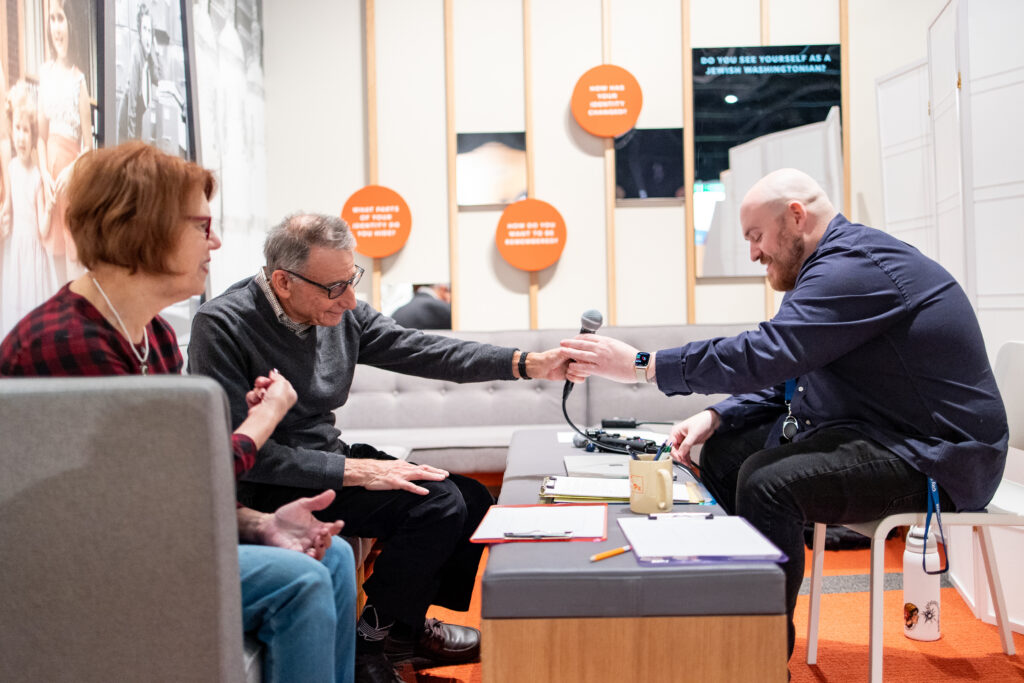
Museum Oral Historian Kerry Reed (right) conducts an oral history interview with a couple during a Grandparent's Day program, November 2025. | Chris Ferenzi Photography.