The Whole Spiel
Deep Dive on a Loving Cup
by Sarah Leavitt, Director of Curatorial Affairs
January 30, 2026
Welcome to Deep Dives with Sarah, where we explore the vast seas of knowledge available to us with a combination of navigational skills and treasure-seeking. You’ll have guessed that today’s topic involves seafaring. As always, this Deep Dive with Sarah also turned into a test of the “wherever you go, there’s always someone Jewish” theory, and—bonus—also involves a Loving Cup, one of my favorite shapes of silver drinking vessel (in case this is not also your favorite kind of drinking vessel, picture a pitcher with two handles on opposite sides, often used as a trophy or award).
The Museum’s initiative to collect, display, and share stories about Jewish federal workers led me to a photograph in our collection featuring the former Chief Historian of the Department of Labor, Jonathan Grossman. Dr. Grossman was also involved with the Jewish Historical Society of Greater Washington, the predecessor to the Capital Jewish Museum, and we have a collection of photographs in our archive relating to his long career at Labor.
One of the photographs shows Jonathan Grossman delivering a Loving Cup to the National Museum of American History (NMAH). The CJM database tells us that the photo is from 1986 and depicts Grossman presenting the cup to Harry Rubinstein, then curator of the Division of Political History at the Smithsonian’s National Museum of American History. (Two Jews in our story, already!) The cup was presented, says the entry, in honor of the Department of Labor’s Diamond Jubilee. The entry also explains that the cup had been originally presented by “various maritime unions of the Pacific Coast” to Secretary of Labor William B. Wilson in 1913.
Interesting! This raised several questions for me. I was especially curious about the relationship between the maritime unions and the Department of Labor. I learned that the origins of Labor go back to when it was combined with the Department of Commerce as a new cabinet-level agency in 1903. Enter Secretary of Commerce and Labor Oscar S. Straus (the first Jewish cabinet member has entered the chat!). In 1906, Secretary Straus became the head of the Department of Commerce and Labor. Commerce and Labor being together in one department made sense to Straus, who said at the time that “Labor and Capital were two arms of industry” and therefore compatible. However, conflict ensued: immigration reform was one area where they disagreed—union leaders at the time wanted to restrict immigration, believing that immigrants brought down wages. Straus, a Bavarian immigrant himself, was against harsh restrictions and exclusion tests for immigrants. He did, however, instruct his team in aggressive implementation of the Anarchist Exclusion Act, detaining and deporting immigrants deemed to be anti-American, the first law to exclude immigrants based on political beliefs.
The US Department of Labor (as separate from Commerce) was founded in 1913 by President Howard Taft, in one of his last acts on the inauguration day of Woodrow Wilson. (Taft, no friend of labor, noted that he signed the bill “with considerable hesitation.”) This had been a long-time goal of the International Seaman’s Union. The first Secretary of Labor, appointed by President Wilson, was William B. Wilson (no relation), who was former Secretary-Treasurer of the United Mine Workers of America.
Back to our Loving Cup. I came to discover that this silver ewer had a more complex life journey than our database had revealed. It was, in fact, given from Secretary of Labor William B. Wilson to the Seamen’s Union in 1913. The cup was then presented back to the Department of Labor in 1936 on the occasion of the department’s 23rd anniversary. It then spent 50 years at Labor. In a 1936 photograph of the Loving Cup’s transfer to Labor that I found online, there are a few people posing. One is Frances Perkins (she’s not relevant, but I always enjoy mentioning the first woman to serve as a US cabinet member); another is Andrew Furuseth. He was a Norwegian immigrant (not Jewish), and at the time, the president of the International Seaman’s Union. He had an interesting career! But that’s a story for another day.
But the journey of the Loving Cup was not complete. In 1986, chief historian Grossman handed it from the Department of Labor to the National Museum of American History. And from there its trail goes cold. I have found various photographs of its transfer, but the cup does not appear in the NMAH database. (Perhaps you would be interested to know that, according to said database, NMAH holds 25 Loving Cups, none of them, sadly, related to Jewish history, and also none of them related to the Department of Labor). Hopefully, our Cup is safe in storage at NMAH, and just not yet in their database. Believe me, if that’s the story, I understand. Archival processing is a journey, and definitely not something I would deign to criticize for going slowly.
So, let’s get back to the history of our federal government, and to Dr. Grossman, the Jewish historian whose collection we hold in our archive. He also believed this history was important to our understanding of American life and was instrumental in forming the Society for History in the Federal Government in 1979. This organization helps ensure, for example, that the stories of the seafaring unions’ efforts to improve harsh conditions for sailors back in the early 1900s are kept and told. In turn, this helps all of us remember the role of the federal government in guaranteeing the rights of American workers and reminds us to protect that legacy in our own time. Grossman, in explaining his theory of the spirit in which the Department of Labor was founded in 1913, reflected that this government agency represented “faith in the perfectibility of man.” And couldn’t we all use a little bit of that faith. Especially if it comes in the shape of a Loving Cup.
***
A Department of Labor-themed exhibition case will be on display in the CJM second-floor lobby beginning February 4, 2026. Other items on display include additional materials from the Jonathan Grossman Collection.
We are always looking for more stories of Jewish federal workers. Is there a box of artifacts (it doesn’t need to be a Loving Cup) or photographs in your house somewhere that might help us preserve and teach the stories of Jewish federal workers? Do you have a history of working for the government, or do you know somebody who does? Please have them email our curatorial staff at: [email protected]. Thank you!
This initiative is supported by Sue Ducat in memory of Stanley Cohen, z”l
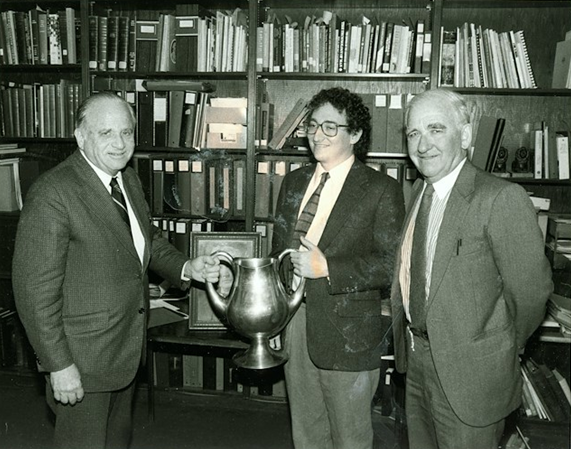
Photograph, 1986. Jonathan Grossman (left) presents a silver loving cup to Harry Rubinstein (center) (Division of Political History for the National Museum of American History) in honor of the Department of Labor's Diamond Jubilee. James Taylor (coordinator for the Diamond Jubilee for the Department of Labor) looks on. Jonathan Grossman Collection, Lillian and Albert Small Capital Jewish Museum. Gift of Marilyn Grossman.