The Whole Spiel
by Sarah Leavitt, Director of Curatorial Affairs
July 22, 2026
I was in the Gelman Library at The George Washington University, reading about the Jewish community’s plans for the Bicentennial, when I came across it for the first time: “A large needlepoint canvas, embodying an appropriate American/Jewish theme.” As a fiber arts crafter myself, this caught my eye. What was the story of this tapestry?
As far as I knew, nobody at the Capital Jewish Museum had ever heard about this Bicentennial canvas. Was it ever completed? How large are we talking? Did it still exist? Could we display it at the Museum? I started getting excited. The document I was reading, a summary of the plans to be undertaken by the Jewish Bicentennial Commission of Greater Washington for the summer of 1976, went on to opine that “the tapestry will be a work of art that will be enjoyed and appreciated for many generations beyond our own.” But was it? As somebody whose job it is to teach Jewish history to all current generations, I started making plans.
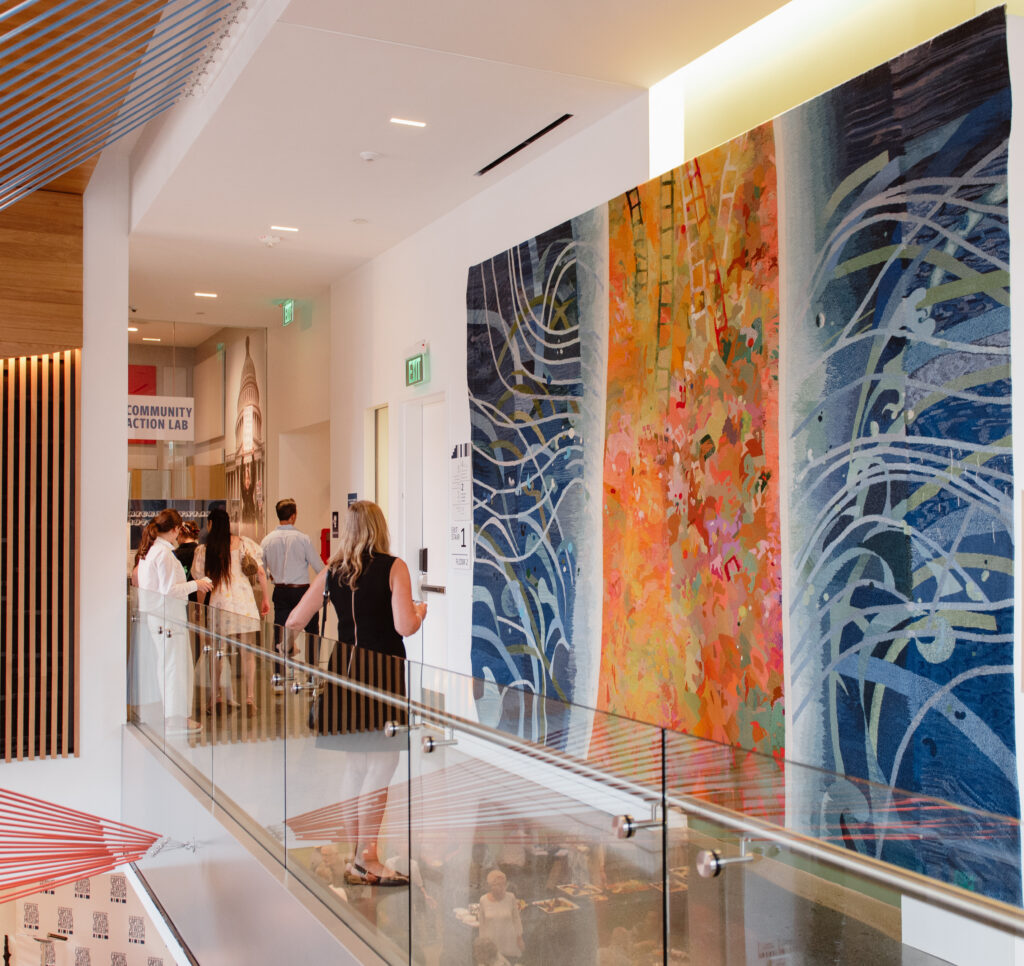
First, I had to find the tapestry. Luckily, that part was relatively easy: the tapestry did still exist and was in the collection of the US Holocaust Memorial Museum, per their online database. And the document from the 1970s was not exaggerating: fully stretched, the piece is 10’ x 14’ (‘large’ is actually kind of an understatement!) Even more luckily, once I emailed their team, the USHMM staff agreed that the Capital Jewish Museum was a more appropriate home for the piece. The tapestry, after all, was designed and crafted by Jewish Washingtonians, and symbolizes the history of the Jewish people seeking freedom in America. We officially transferred the work to CJM this summer.
At first, we thought the tapestry was conceived, designed, and completed in time for the Bicentennial and was displayed for the public to see. But, as usual, research makes everything both more complicated and more interesting. In the past few months, we’ve been able to talk with folks who remember the piece from the 1970s, and who thankfully saved folders filled with invoices, memos, letters, notes, newspaper clippings, and other ephemera.
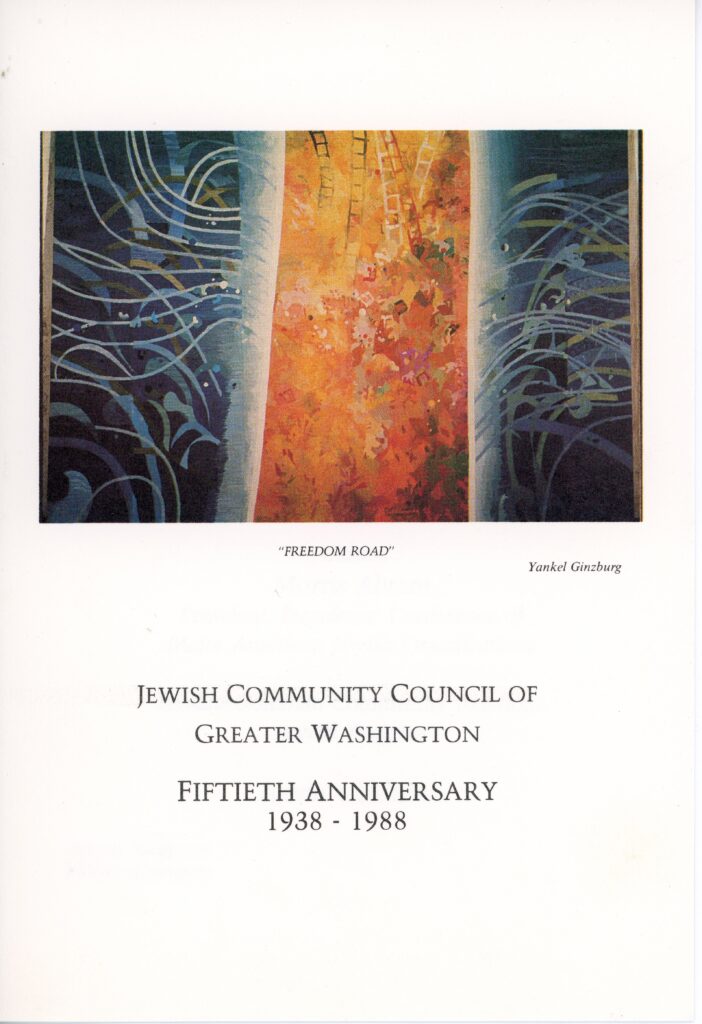
In 1976, the Jewish Bicentennial Commission hired local artist Yankel Ginzburg to design and paint a tapestry as part of a three-part Bicentennial plan. The Commission also sponsored a symposium on the themes of Jews and democracy and published a Jewish DC walking tour in a guidebook. Ginzburg, the tapestry’s designer, was a fixture in the DC art gallery scene in the 1970s, and was part of the “school of light,” an offshoot of the Washington Color School. As the resident artist at the Camp David Accords a few years later, Ginzburg solidified his reputation as a diplomatic artist, and often worked with intertwined themes of Jewish faith and patriotism. He described his Bicentennial tapestry as “a contemporary semi-abstract depiction of the parting of the waters of the Red Sea, the journey from bondage to freedom—the trek of the Hebrew slaves; the long and perilous voyages of our Pilgrim Fathers who allegorically saw themselves in this Biblical light.”
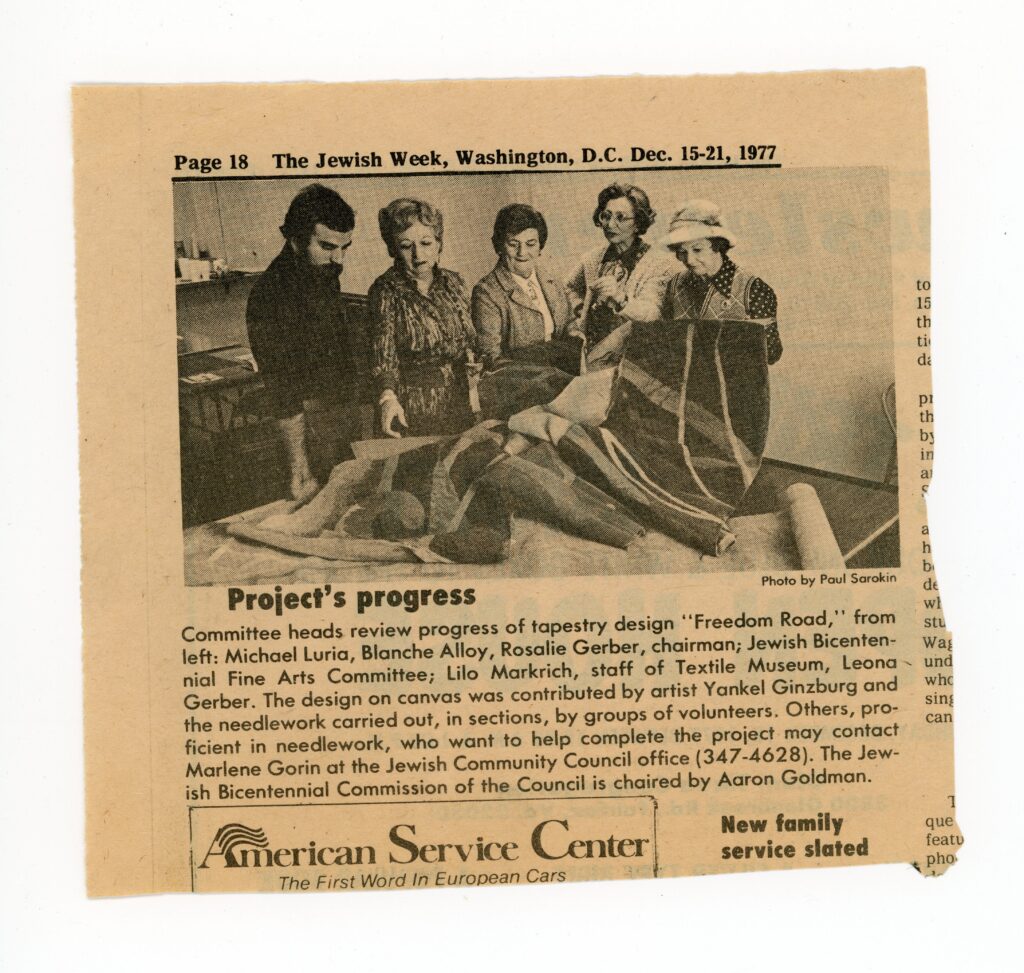
The process from design to needlework to the first installation took over 18 years, an auspicious number for a Jewish project, but a long journey nonetheless. First, the artist and his assistant painted the design onto the canvas, laid out on the floor in the Gewirz auditorium at Adas Israel Congregation in DC. That summer, a consultant from the Textile Museum purchased supplies, including specialty wool, on a trip to Europe. Meanwhile, prospective needle pointers received instructions: they had a month to send samples showing the “regularity” of their tent stitch. Organizers chose eight captains (representing DC, Montgomery County, and Northern Virginia) to marshal the crafters—60 woman and 1 man—to produce the work.
The process took ten years. Kenny Margolius remembered: “Both my mother and aunt were always accompanied by a piece of the tapestry on which they needlepointed – tirelessly – throughout the evening, every Friday evening. For YEARS! They were a large part of the 20.000 woman hours that created the heroic sized tapestry.” Indeed, for the dozens of DC-area crafters who worked on this project, the needlepoint tapestry took over their leisure time for a decade. It is truly a labor of love (and probably some frustration, as well).
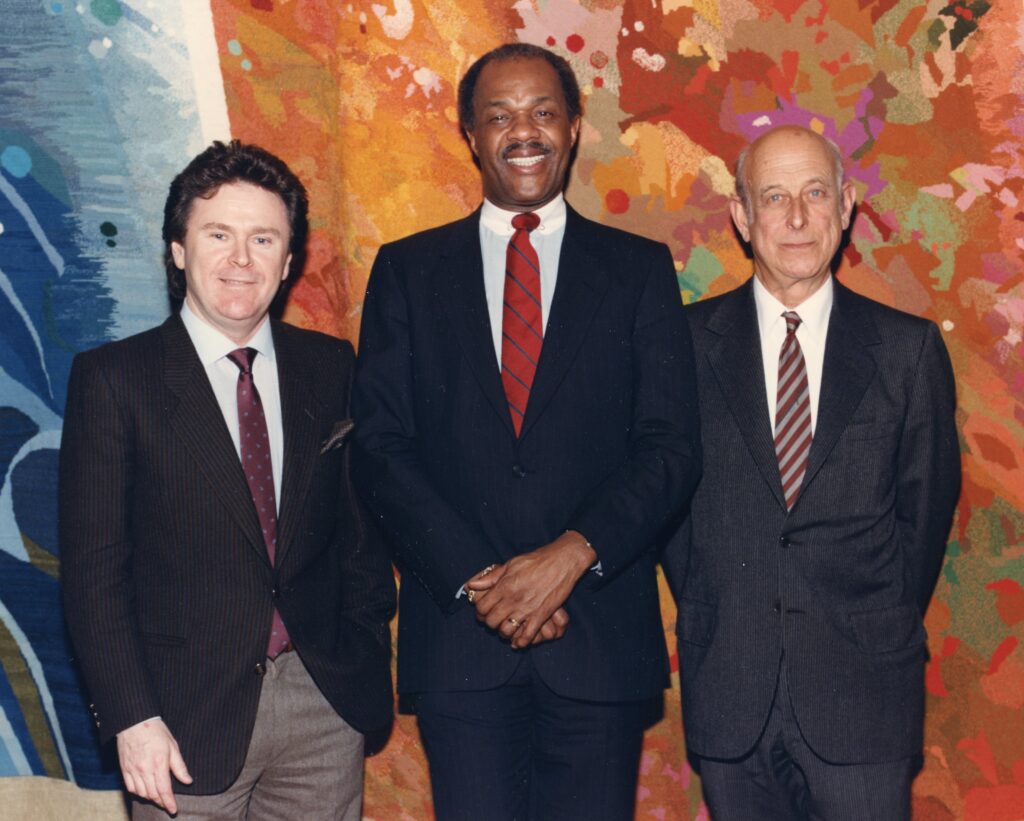
But even with all this work over a decade of long nights with needles and yarn, the tapestry was not complete. In 1985, Aaron Goldman, acting on behalf of the Jewish Community Council which had taken over the project, hired Lilo Markrich (1923-2022) to finish the work. Markrich, a fiber artist who worked for the Textile Museum’s gallery shop, stepped in with an estimated 500+ hours (she said she stopped counting at 500) to join and complete the panels. The tapestry was then sent to a luxury carpet importer and restorer in Manhattan. In the summer of 1986, A. Beshar & Company stretched the piece onto a frame for hanging. The following year, Goldman’s daughter and son-in-law, Phillis and Philip Margolius, displayed the piece in their home as they waited for the next chapter of the tapestry’s journey.
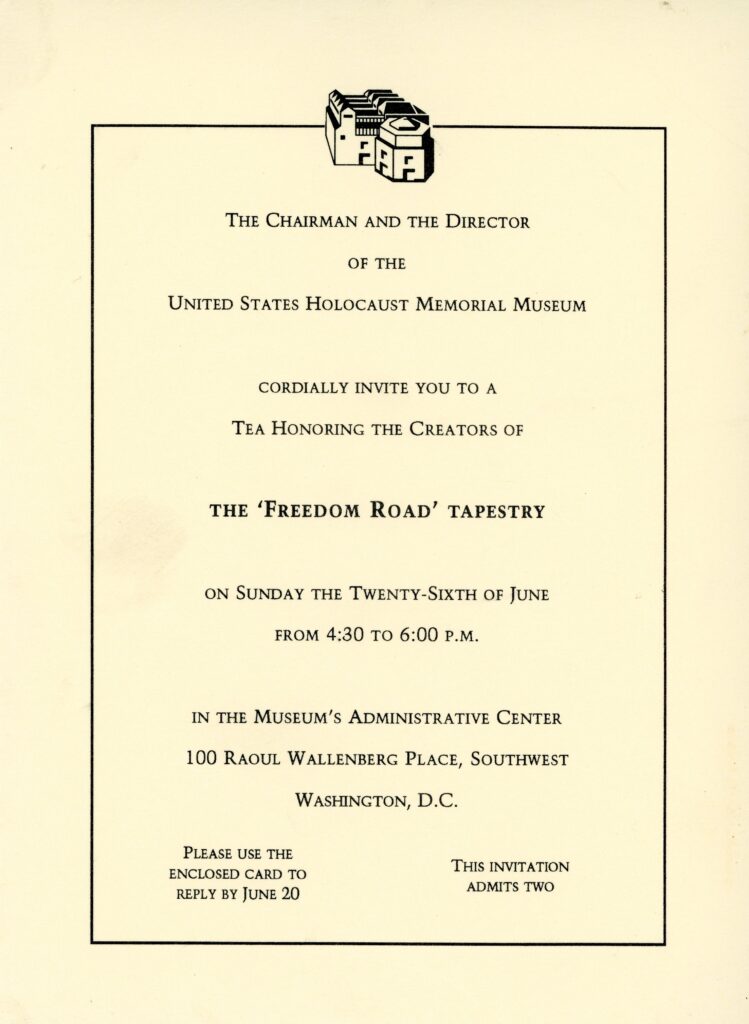
In 1987, the Jewish Community Council donated the tapestry to the US Holocaust Memorial Museum, with the request that the museum would display the work once it opened. The idea was that “it will be permanently displayed—the first major work of art accepted by the Museum from any American Jewish community.” For a few years, from 1994 through 1996, the tapestry was, indeed, temporarily displayed in the museum’s Administrative Annex. Much to the disappointment of many folks at the Jewish Community Council, the piece was removed after a few years, taken off the wooden frame, carefully rolled up for its own protection, and put in long-term storage in Maryland. And there it remained, for the next two decades, until I read about it in the files at the Gelman Library.
Thanks to the support of our generous donors, some of whom remembered the tapestry fondly, we were able to hang the tapestry in the second-floor hallway, where it can be seen for free by the general public for really the first time in its history. The bright colors and dramatic design have been a wonderful way for Museum visitors this summer to visualize the ideas represented by the parting of the Red Sea and the ancient search for freedom. We invite you to come see us this summer, visit Blacklisted: An American Story and our permanent exhibitions, have some coffee in the Cafritz Lobby, peruse the Gewirz Gift Shop. Spend some time with this tapestry and take the opportunity to think about the meanings of creativity, teamwork, and persistence that it represents.
Images Courtesy of Phil Margolius and AB Corson Photography
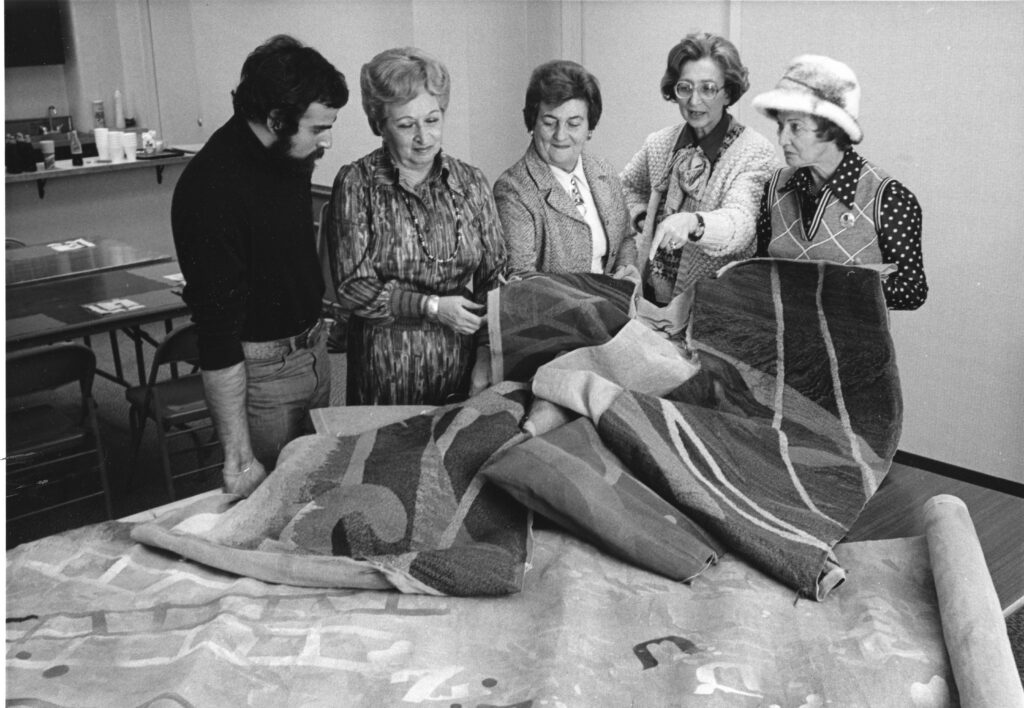
Committee heads review progress of tapestry: from the left, Michael Luria, Blanche Alloy, Rosalie Gerber, Lilo Markrich, Leona Gerber, 1977